
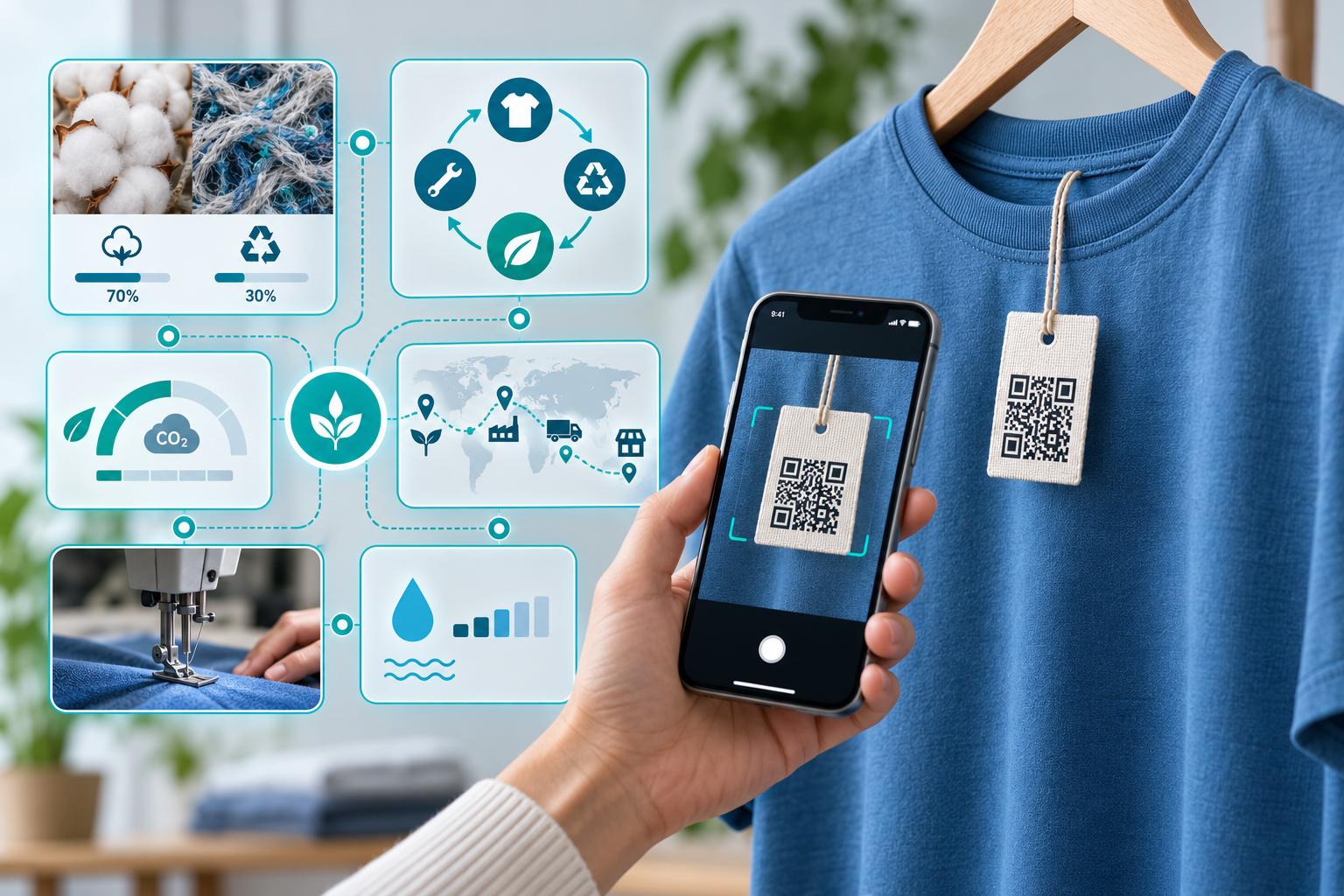
The European Union is moving forward with Digital Product Passport (DPP) requirements for textile and apparel products, marking an important step toward greater transparency, circularity and traceability across the sector.
Textile apparel has been identified as one of the priority product groups under the Ecodesign for Sustainable Products Regulation (ESPR) Working Plan 2025-2030. Future textile-specific ecodesign requirements are expected to be accompanied by requirements for Digital Product Passports.
For manufacturers, importers, distributors and other businesses operating within textile value chains, this means that structured and accessible product data is set to become increasingly important.
Why textiles are a priority
The textile industry represents a significant part of the European economy. According to the European Commission, approximately 194,000 textile companies operate in the EU, generating around €166 billion in annual turnover.
At the same time, textile consumption has a substantial environmental footprint. From a global life-cycle perspective, EU textile consumption has been identified as having the fourth-highest impact on the environment and climate change, and the third-highest impact on water and land use.
Apparel represents the largest textile subgroup by apparent consumption, reaching approximately 4.85 billion kg in 2019, compared with 3.28 billion kg for home and interior textiles and 3.55 billion kg for technical textiles.
These economic and environmental factors make textiles an important area for the EU's transition toward more sustainable and circular products.
What will the Digital Product Passport do?
The DPP is intended to provide structured access to relevant information about a textile product throughout its lifecycle.
For businesses, it can provide a mechanism for communicating verified product information and demonstrating sustainability and circularity characteristics.
For consumers, it is expected to make trustworthy product information easier to access when making purchasing decisions.
The information can also support downstream participants in the value chain, including businesses involved in repair, reuse, resale, refurbishment and recycling.
In this way, the Digital Product Passport is more than a digital label. It is intended to support the flow of product information between different participants throughout the product lifecycle.
What information could a textile DPP contain?
The final textile-specific requirements have not yet been established. They will be defined through the relevant ESPR delegated act and supporting technical specifications.
Depending on those final requirements, a textile Digital Product Passport may include information such as:
Product identification and key characteristics
Fibre composition, where relevant under EU textile labelling requirements
Information supporting proper use, maintenance and repair
Information relevant to reuse and resale
Disassembly and refurbishment information
End-of-life and recycling information
Product origin information
Identification of relevant economic operators
Compliance, conformity and traceability documentation where required
The exact datasets, data structure and access requirements will become clearer as the delegated act and associated technical specifications are developed.
How will consumers and businesses access the DPP?
According to the European Commission's current framework, Digital Product Passport information will be accessible digitally.
For physical products, access is expected to be provided through a data carrier attached to or associated with the product, such as a QR code. DPP information will also need to be accessible in relevant online sales environments.
Scanning the data carrier would provide access to the information applicable to the product and user, while authorities would be able to access information necessary for compliance and conformity purposes according to the applicable rules.
This creates a connection between the physical textile product and its digital product information.
Which businesses will be affected?
The primary responsibility is expected to fall on economic operators that place textile apparel products on the EU market or put them into service within the EU.
Depending on the circumstances, these businesses may include:
Manufacturers
Producers
Importers
Other participants, including distributors and dealers, will have responsibilities related to ensuring that the required DPP is available for products they distribute within the EU market.
Suppliers and service providers may also have obligations to provide relevant product information available to them.
For textile businesses, this means DPP readiness is likely to extend beyond simply creating a QR code. Companies will need to consider where required product information originates, how it is structured, how it is maintained and how it moves between supply-chain partners.
When are textile DPP requirements expected?
The European Commission currently provides the following indicative timeline:
Q4 2027 - Planned adoption of the ESPR Delegated Act for textiles
Following adoption, additional technical specifications, implementation measures and guidance are expected to support implementation of the textile DPP requirements.
The Commission emphasizes that this timeline is indicative and may change as legislative and technical work progresses.
What textile companies can start preparing now
Although the final requirements are still being developed, companies do not necessarily need to wait for the delegated act before assessing their DPP readiness.
Businesses can begin by examining:
What product and material data they currently maintain
Where information about fibres, materials and components originates
How products are uniquely identified
How supplier information is collected and exchanged
Whether sustainability and circularity information is structured and verifiable
How product information is updated throughout the lifecycle
How data could be made available digitally to consumers, business partners and authorities
Preparing the underlying data and traceability infrastructure can help businesses adapt more efficiently once the final textile-specific requirements become clear.
Digitrace and Digital Product Passports
At Digitrace, we are following the development of the European Digital Product Passport framework and its implications for manufacturers, brands, importers and supply-chain partners.
Digital Product Passports bring together product identification, structured data, traceability and accessible digital information. As requirements evolve, businesses will increasingly need practical ways to connect physical products with reliable digital product records and manage information across their value chains.
Digitrace helps businesses prepare for this transition by enabling the creation and management of Digital Product Passports and product-level digital information, helping turn regulatory requirements into practical product and supply-chain processes.
Source and attribution
This article is based on information published by the European Commission, Directorate-General for Internal Market, Industry, Entrepreneurship and SMEs (DG GROW) on “Textile Apparel and the Digital Product Passport (DPP)”.
Original source: European Commission - Textile Apparel and the Digital Product Passport (DPP)
https://single-market-economy.ec.europa.eu/single-market/digital-product-passport/textile-apparel_en
Adapted and edited by Digitrace.
European Commission content is reused in accordance with the European Commission's reuse policy and Creative Commons Attribution 4.0 International (CC BY 4.0), where applicable.
Note: The regulatory requirements and implementation timeline described above remain subject to the adoption of relevant delegated acts, technical specifications and further guidance. Businesses should consult the latest official European Commission publications when making compliance decisions.